The published formula
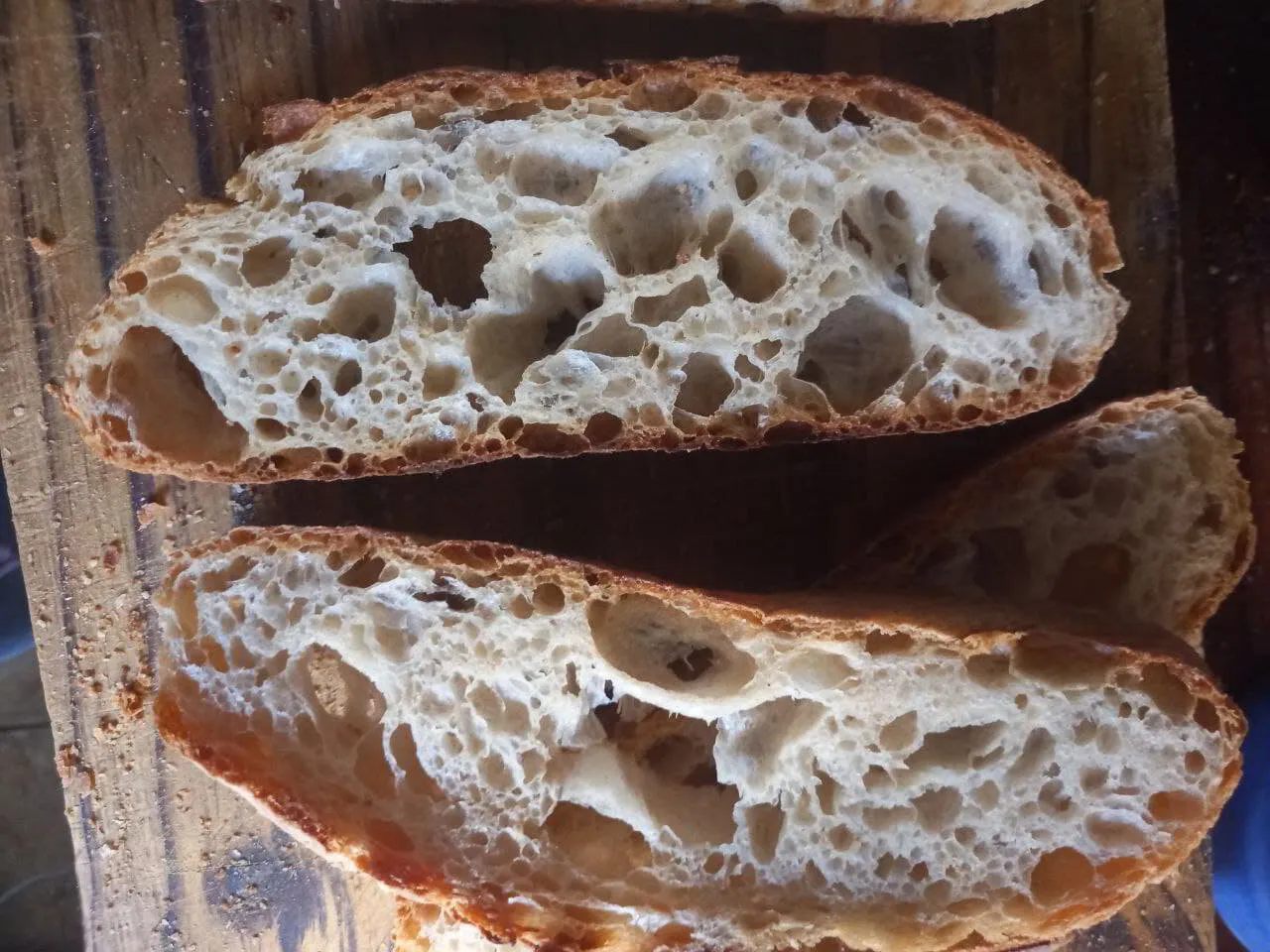
A yeast-poolish ciabatta, in full.
This edition carries forward John Deacon’s published ingredient quantities and method. The preferment uses instant baker’s yeast; it is not a sourdough formula. The original timing and oven ranges remain visible, alongside the hydration calculation and practical context.
Formula
Two stages.
Poolish · 12–18 hours
- Flour300 g
- Water300 g
- Instant yeast¼ tsp
Main dough
- Flour700 g
- Water400 g
- Salt1 tbsp
- Instant yeast1½ tsp (about 7 g)
The original publication measures salt by volume. Salt density and spoon size vary, so this edition retains the source measure instead of implying an exact conversion.
Method · source-published
Work in stages; read the dough.
- Mix the poolish. Stir together 300 g flour, 300 g water, and ¼ teaspoon yeast. Cover and leave for 12–18 hours, following the original method. Temperature affects the rate of fermentation, so observe the poolish as well as the clock.
- Make the main dough. Add the remaining flour and water, salt, and yeast to the poolish. Mix until combined, then allow the dough to rest as the source method directs.
- Fold during bulk fermentation. The published method specifies three folds at roughly 45-minute intervals. With a damp hand, lift and fold the dough gently, developing organization without tearing it.
- Divide and rest. Turn the dough onto a well-floured surface and divide it into two pieces. Rest for about 15 minutes before shaping, as stated in the source.
- Proof and bake. Transfer the loaves to a hot oven. The source gives 250–300°C and 25–35 minutes. Treat those as the published equipment-dependent ranges; monitor the loaf’s expansion, colour, and set.
300 g poolish flour + 700 g main-dough flour = 1,000 g flour. Total water is 700 g: 70% hydration.
The quantities and timing ranges above preserve the published method. Flour performance, room temperature, and oven calibration affect how the process unfolds; record them when you bake.
Measure the formula. Record the conditions. Read the dough.